
Charles William Stores Fall & Winter 1919 Catalogue
Historic bound paper documents frequently exhibit inherent vice. Lignin- and acid-free paper rarely appeared until recently, and even without these concerns, bindings deteriorate from frequent use, and damage accumulates. Conservators fight a delaying battle, weighing access against preservation. Conservation expenses can easily reach thousands of dollars for a single volume, and most institutions charged with caring for documents struggle to rebind and preserve even a meaningful portion of their collections.
Fortunately, an inexpensive option exists to aid preservation. Boxing a bound volume does not improve its condition, but with a little time and minimal expenses, it serves as an accessible action that even low-budget institutions can utilize to minimize deterioration from handling and storage.
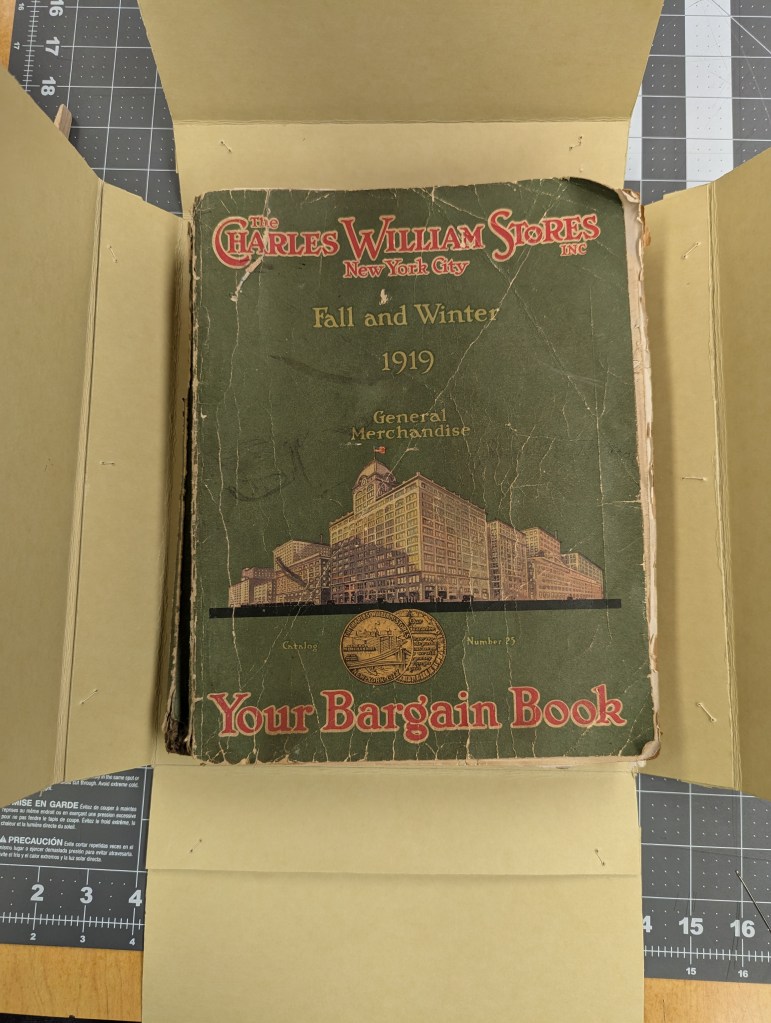
Mail-order catalogues–the “Amazon” of the 19th to late-20th centuries–offer extensive insight to the material culture of their times. Sadly for historians, their publishers constructed them for use for only a season, or perhaps a year, before replacement. Their vulnerability makes them “Prime” candidates for boxing. The 1919 Charles William catalog above suffers from acid-embrittled paper, loose sheets, and a bent spine.

Conservation and museum supply stores offer several sizes of pre-made boxes, but the volume should fit snuggly to prevent movement, and with a little practice, anyone can neatly build a custom-fit storage solution. Required materials include acid-free archival cardboard, a steel rule, and Exacto-type knife. A little planning makes the job easier, and avoids waste. The Charles William catalog required a little extra room to accommodate its distorted spine.

This design can be cut from a single sheet, but a conservator can also cut and then stitch separate flaps with simple cotton thread, conserving supplies as well as the volume. Carefully score bends with the knife before forming them for a sharp, neat appearance.

A simple square of adhesive hook-and-fastener tape secures the closure.

In spite of the boxing, this catalog remains unsuitable for upright shelving, and belongs in horizontal storage, although it can now be stacked with other volumes more confidently. Assess the condition and stability, and employ common sense. With a little effort, any institution can prolong the life of its increasingly irreplaceable resources, even on a budget.
Special thanks to Dr. Karin Bohleke, Director of the Fashion Archives & Museum of Shippensburg University, who teaches object mounting as part of HIST 542: Textile History & Museum Methods at Shippensburg University
 Historical Chesnuts
Leave a comment